


The Two Egg Problem
 |
There’s an interesting mind-teaser/puzzle that floats around the internet in waves. Sometimes it’s described as a Google interview question; sometimes it’s described as a Microsoft
interview question. No matter of the origin, it’s a fun little
critical thinking puzzle and in this blog posting I’m going to look into
it and take it a little further …
|
Puzzle Definition

|
You are given two eggs, and access to a
100-storey building. Both eggs are identical. The aim is to find out
the highest floor from which an egg will not break when dropped
out of a window from that floor. If an egg is dropped and does not
break, it is undamaged and can be dropped again. However, once an egg
is broken, that’s it for that egg.
If an egg breaks when dropped from floor n,
then it would also have broken from any floor above that. If an egg
survives a fall, then it will survive any fall shorter than that.
The question is: What strategy should you adopt to minimize the number egg drops it takes to find the solution?. (And what is the worst case for the number of drops it will take?)
|
There are no tricks, gotchas or other devious ruses.
Don’t rat-hole with issues related to terminal velocity, potential
energy or wind resistance. This is a math puzzle plain and simple.
Think about the puzzle for a few minutes, and then read on.
One Egg
|
Whilst it’s not strictly part of the puzzle, let’s first imagine what we’d do if we had only one egg.
Once this egg is broken, that’s it, no more egg. So,
we really have no other choice but to start at floor 1. If it survives,
great, we go up to floor 2 and try again, then floor 3 … all the way up
the building; one floor at a time. Eventually the egg will break*
and we’ll have a solution. For example, if it breaks on floor 57, we
know that the highest floor that an egg can withstand a drop from is
floor 56.
There’s no other one egg solution. Sure, if we’d been feeling lucky we could
have gone up the floors in two’s but imagine if the egg broke on floor
16; we have no way of knowing if it would have also broken on floor 15!

* Of course there is a chance that the egg will not break on floor 100, and this is a valid solution.
|
 |
Many Eggs
 |
At the other extreme, what if we had an infinite number
of eggs? (Or at least as many eggs as we need). What would our strategy
be here? In this case we’d use one of a programmer’s favorite tools,
the binary tree.
First we’d go to floor 50 and drop an egg. It either
breaks, or it does not. The outcome of this drop instantly cuts our
problem in half. If it breaks, we know the solution lives in the bottom half of the building (floor 1 – floor 49). If it survives, we know the solution is in the top
half of the building (floor 51 – 100). On each drop, we keep dividing
the problem in half and half again until we get to our solution.
The mathematicians in the audience will quickly see that the number of drops required for this solution is log2 n, where n is the number of floors of the building. (This is like asking how many powers of two there are).
Because this building does not have a number of floors
equal to a round number power of two, we need to round up to number of
drops to get seven ( log2 100 = 6.644 )
(Using seven drops, we could solve this problem any
building up to 128 floors. Eight drops would allow us to solve the
puzzle for a building with twice the height at 256 floors …)
Depending on the final answer, the actual number of eggs
broken using a binary search will vary. At worst it will be seven eggs
(if the floor is actually floor 1, since every drop will break the
egg). At best it will be no eggs (if the actually answer is floor 100,
since the egg will survive every drop made).
(There's a very interesting lesson here which I'll cover in a future posting: Understanding the difference between Expected Answer and Worst Case Answer. These can be very different things!)
|
Back to two eggs
OK, let’s get back to the original two egg problem. As we’ve seen from above, the worst case using a binary search would break seven eggs; not acceptable when we only have two eggs.
It does not take much imagination to see why a binary
search solution will not work (optimally) for two eggs. Let’s imagine
we did try a binary search and dropped our first egg from floor 50. If
it broke, we’d be instantly reduced to a one egg problem, so then we
would have to start with our last egg from floor 1 and keep going up one
floor at a time until that breaks. As a worst case, it will take us 50
drops. We can do better …
|
What happens if we started off with our first egg going up by floors ten
at a time? We can start dropping our egg from floor 10; if it survives
we try floor 20, then floor 30 … we carry on until the first egg
breaks. Once we’ve broken our first egg we know that the solution must
lay somewhere in the nine floors just below, so we back off nine floors and step through these floors one at a time until we find a solution.
|
 |
This is certainly an improvement, but what is our worst case with this strategy? Well, imagine we dropped eggs on every 10th
floor all the way up, and our first egg broke on floor 100. This has
taken us ten drops so far. Now we know the solution must lay somewhere
between floor 91 and floor 99 and we have to go through these in ones,
starting at floor 91. The worst case would be if the solution was on
floor 99, and this would take us nine more drops to determine. The
worst case therefore, if we go by tens, is 19 drops.

|
This is a huge improvement, but can we do better? |
|
Thinking about the 10 floor strategy again we can see that, whilst our worst
case is 19 drops, some other possible solutions will take less than
this (for instance, if the first egg broke on floor 10 then, at worst,
from here we only have to make nine more drops to find the solution).
Knowing that, what if we dropped our first egg from floor 11
instead? If the egg breaks on this floor, it will still only take ten
more drops to find the solution (and if it doesn’t break, great, we’ve
eliminated more floors than before! win-win?) Let's follow this idea,
and see where it leads …
 |
Well, how about if we dropped our first egg from floor 12
then? A similar argument to above; if it breaks, we only have to try
eleven floors with the second egg. If it doesn’t break, we can step up
another dozen floors, and so on … But hold on a minute! … If first we
try floor 12, then 24, then 36, then 48, 60, 72, 84, 96 then it finally
breaks, we’ve wasted eight drops already, and we still have to check
(up to) eleven more floors with our second egg, so we’re back at a worst
case of 19 drops.
Problems
where the solution lays lower down the building are taking less drops
than when the solution lays higher up. We need to come up with a
strategy that makes things more uniform.
|
Minimization of Maximum Regret
|
What we need is a solution that minimizes our maximum
regret. The examples above hint towards what we need is a strategy that
tries to make solutions to all possible answers the same depth (same
number of drops). The way to reduce the worst case is to attempt to
make all cases take the same number of drops.
|
 |
As I hope you can see by now, if the solution lays
somewhere in a floor low down, then we have extra-headroom when we need
to step by singles, but, as we get higher up the building, we’ve already
used drop chances to get there, so there we have less drops left when we have to switch to going floor-by-floor.
Let’s break out some algebra.
Imagine we drop our first egg from floor n, if it breaks, we can step through the previous (n-1) floors one-by-one.
If it doesn’t break, rather than jumping up another n floors, instead we should step up just (n-1) floors (because we have one less drop available if we have to switch to one-by-one floors), so the next floor we should try is floor n + (n-1)
Similarly, if this drop does not break, we next need to jump up to floor n + (n-1) + (n-2), then floor n + (n-1) + (n-2) + (n-3) …
We keep reducing the step by one each time we jump up,
until that step-up is just one floor, and get the following equation for
a 100 floor building:
n + (n-1) + (n-2) + (n-3) + (n-4) + … + 1 >= 100
This summation, as many will recognize, is the formula
for triangular numbers (which kind of makes sense, since we’re reducing
the step by one each drop we make) and can be simplified to:
n (n+1) / 2 >= 100
This is a quadratic equation, with the positive root of 13.651 (Which we have to round up to 14. This is not a John Malkovich movie!).
Two egg solution
We now have all the information to compute the optimal two egg solution.
|
Our first drop should be from floor 14, if egg survives we step up 13 floors to floor 27, then up 12 floors to 39 …
The optimal strategy is to work our way through the
table until the first egg breaks, then back up to one floor higher than
the line above and then proceed floor-by-floor until we find the exact
solution.
This complete table is shown in here on the left.
The maximum of 14 drops is a combination first egg drops
(made in steps), and second egg drops (made in ones). For every drop
we take hopping up the tower, we reduce the worst-case number of single
drops we’d have to take so that no solution is an outlier.
|
“Look see I can do three” *
|
* “Ten Apples Up On Top” – Dr. Seuss
|
Why stop at two eggs? What is the optimal strategy if we had three eggs? (Dare I say four? five? …)
Things get more complex with three eggs, but taking a
deep breath we can apply the same principle of minimizing maximum
regret. We need to select our first egg such that, if it breaks, or
does not break, it results in a problem, which recursively is now a two
egg problem, that we already know how to solve to minimize maximum
regret!
OK hold on tight, here we go …
Let's define our building to have a maximum of k floors. Let's say that the number of egg we have is represented by e, and the floor we are currently attempting to drop from is represented by n.
With me so far? OK, what we need to find our optimal solution is to
calculate what would happen if we dropped an egg from every floor (1 through to k)
and (recursively) calculate the minimum number of droppings needed in
the worst case. We're looking for the floor that gives the minimum solution to the worst case.
If we drop an egg from floor n, one of two events happens:
1) The egg breaks, so now our problem is reduced to a tower of height n-1, and we now have e-1 eggs.
2) The egg doesn't break and now we need to check k-n floors and we still have e eggs.
Remember we need to mimimize the number of drops in the
worst case, so we take the higher (max) of these two situations, and
select the floor which yields the minimum number of drops.
The code to solve this is fairly easy to write
recursively, but suffers from a common problem that occurs with
recursive solutions in which the same sub-problems are evaluated again,
and again, and again, dragging performance to a grind for anything other
than trivial solutions. To get around this, we need to keep track of
values already computed so that we don't have to repeat the calculation.
Rather than getting lost in gnarly code, let's just share some of the results, and for some buildings higher than 100 stories.
Lots of of eggs, and lots of floors

Here's a table showing the worst case number of drops it would take for a variety of floors with anywhere from 1 – 10 eggs.
| Eggs | ||||||||||
|---|---|---|---|---|---|---|---|---|---|---|
| Building Height | 1 | 2 | 3 | 4 | 5 | 6 | 7 | 8 | 9 | 10 |
| 1 floor | 1 | 1 | 1 | 1 | 1 | 1 | 1 | 1 | 1 | 1 |
| 2 floors | 2 | 2 | 2 | 2 | 2 | 2 | 2 | 2 | 2 | 2 |
| 3 floors | 3 | 2 | 2 | 2 | 2 | 2 | 2 | 2 | 2 | 2 |
| 4 floors | 4 | 3 | 3 | 3 | 3 | 3 | 3 | 3 | 3 | 3 |
| 5 floors | 5 | 3 | 3 | 3 | 3 | 3 | 3 | 3 | 3 | 3 |
| 6 floors | 6 | 3 | 3 | 3 | 3 | 3 | 3 | 3 | 3 | 3 |
| 7 floors | 7 | 4 | 3 | 3 | 3 | 3 | 3 | 3 | 3 | 3 |
| 8 floors | 8 | 4 | 4 | 4 | 4 | 4 | 4 | 4 | 4 | 4 |
| 9 floors | 9 | 4 | 4 | 4 | 4 | 4 | 4 | 4 | 4 | 4 |
| 10 floors | 10 | 4 | 4 | 4 | 4 | 4 | 4 | 4 | 4 | 4 |
| 11 floors | 11 | 5 | 4 | 4 | 4 | 4 | 4 | 4 | 4 | 4 |
| 12 floors | 12 | 5 | 4 | 4 | 4 | 4 | 4 | 4 | 4 | 4 |
| 13 floors | 13 | 5 | 4 | 4 | 4 | 4 | 4 | 4 | 4 | 4 |
| 14 floors | 14 | 5 | 4 | 4 | 4 | 4 | 4 | 4 | 4 | 4 |
| 15 floors | 15 | 5 | 5 | 4 | 4 | 4 | 4 | 4 | 4 | 4 |
| 16 floors | 16 | 6 | 5 | 5 | 5 | 5 | 5 | 5 | 5 | 5 |
| 17 floors | 17 | 6 | 5 | 5 | 5 | 5 | 5 | 5 | 5 | 5 |
| 18 floors | 18 | 6 | 5 | 5 | 5 | 5 | 5 | 5 | 5 | 5 |
| 19 floors | 19 | 6 | 5 | 5 | 5 | 5 | 5 | 5 | 5 | 5 |
| 20 floors | 20 | 6 | 5 | 5 | 5 | 5 | 5 | 5 | 5 | 5 |
| 21 floors | 21 | 6 | 5 | 5 | 5 | 5 | 5 | 5 | 5 | 5 |
| 22 floors | 22 | 7 | 5 | 5 | 5 | 5 | 5 | 5 | 5 | 5 |
| 23 floors | 23 | 7 | 5 | 5 | 5 | 5 | 5 | 5 | 5 | 5 |
| 24 floors | 24 | 7 | 5 | 5 | 5 | 5 | 5 | 5 | 5 | 5 |
| 25 floors | 25 | 7 | 5 | 5 | 5 | 5 | 5 | 5 | 5 | 5 |
| 30 floors | 30 | 8 | 6 | 5 | 5 | 5 | 5 | 5 | 5 | 5 |
| 35 floors | 35 | 8 | 6 | 6 | 6 | 6 | 6 | 6 | 6 | 6 |
| 40 floors | 40 | 9 | 6 | 6 | 6 | 6 | 6 | 6 | 6 | 6 |
| 45 floors | 45 | 9 | 7 | 6 | 6 | 6 | 6 | 6 | 6 | 6 |
| 50 floors | 50 | 10 | 7 | 6 | 6 | 6 | 6 | 6 | 6 | 6 |
| 100 floors | 100 | 14 | 9 | 8 | 7 | 7 | 7 | 7 | 7 | 7 |
| 200 floors | 200 | 20 | 11 | 9 | 8 | 8 | 8 | 8 | 8 | 8 |
| 300 floors | 300 | 24 | 13 | 10 | 9 | 9 | 9 | 9 | 9 | 9 |
| 400 floors | 400 | 28 | 14 | 11 | 10 | 9 | 9 | 9 | 9 | 9 |
| 500 floors | 500 | 32 | 15 | 11 | 10 | 10 | 9 | 9 | 9 | 9 |
| 1,000 floors | 1000 | 45 | 19 | 13 | 11 | 11 | 11 | 10 | 10 | 10 |
A graphs is worth a thousand floors
Here's the data plotted in graphical form. The y-axis represents the worst case number of drops needed to find the solution. The x-axis
represents the number of floors in the building being tested (from 1 –
1000). There is a distinct line for each number of eggs.
[CLICK GRAPH FOR LARGER VERSION]
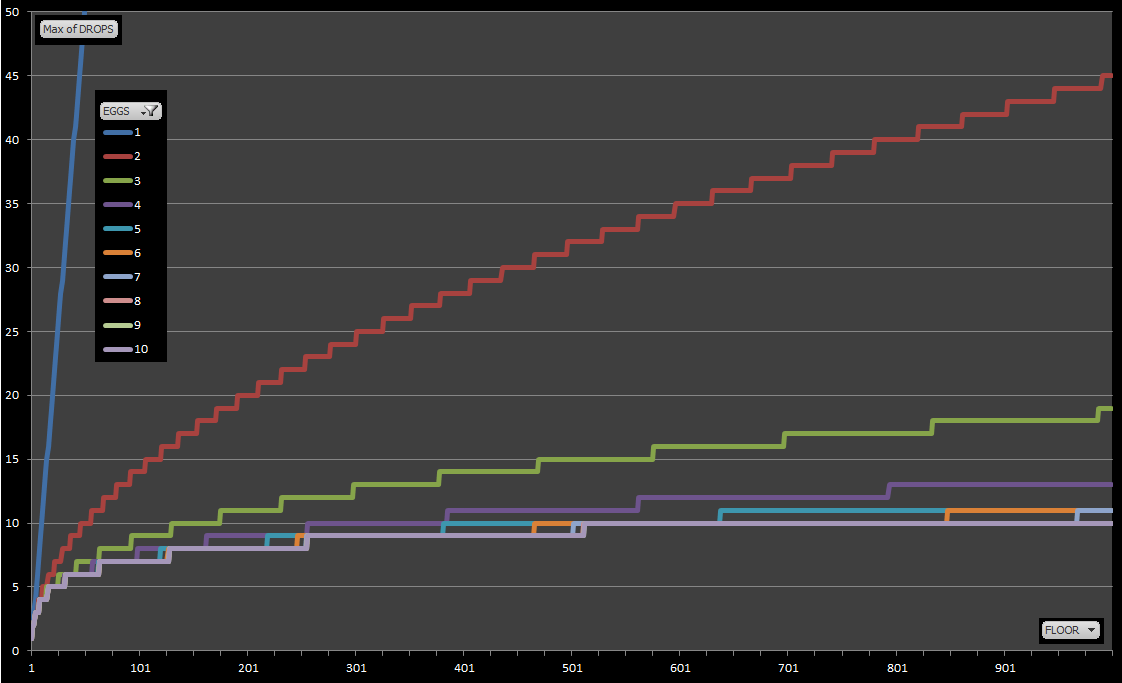
The blue line, representing the one egg solution, has a
gradient of 1 and for every building, the worst case number of drops is
the same as the number of floors.
Adding an extra egg to make two eggs makes a huge difference. Adding a third egg makes a smaller difference again.
For small numbers of floors and larger numbers of eggs,
the solutions merge as we end up having excess eggs and the solution
simplifies to that of the binary search as we discussed at the beginning
of this article.
That's an awful lot of omelettes!
